
History of gemstones
Nine stones, and a few centuries of looking carefully.
India did not invent gems. It did invent a language for them — graha, rashi, navratna — that a jewellery house is still obliged to speak without theatre.
c. 6th century
Buddhabhatta’s Ratnapariksha
One of the earliest surviving Indian gem treatises. It names ruby, pearl, coral, emerald, yellow sapphire, diamond, blue sapphire, hessonite and cat’s eye — the nine that still sit in a Navratna tray — and teaches how to look at colour, weight and inclusion.
Temple centuries
Stones as architecture
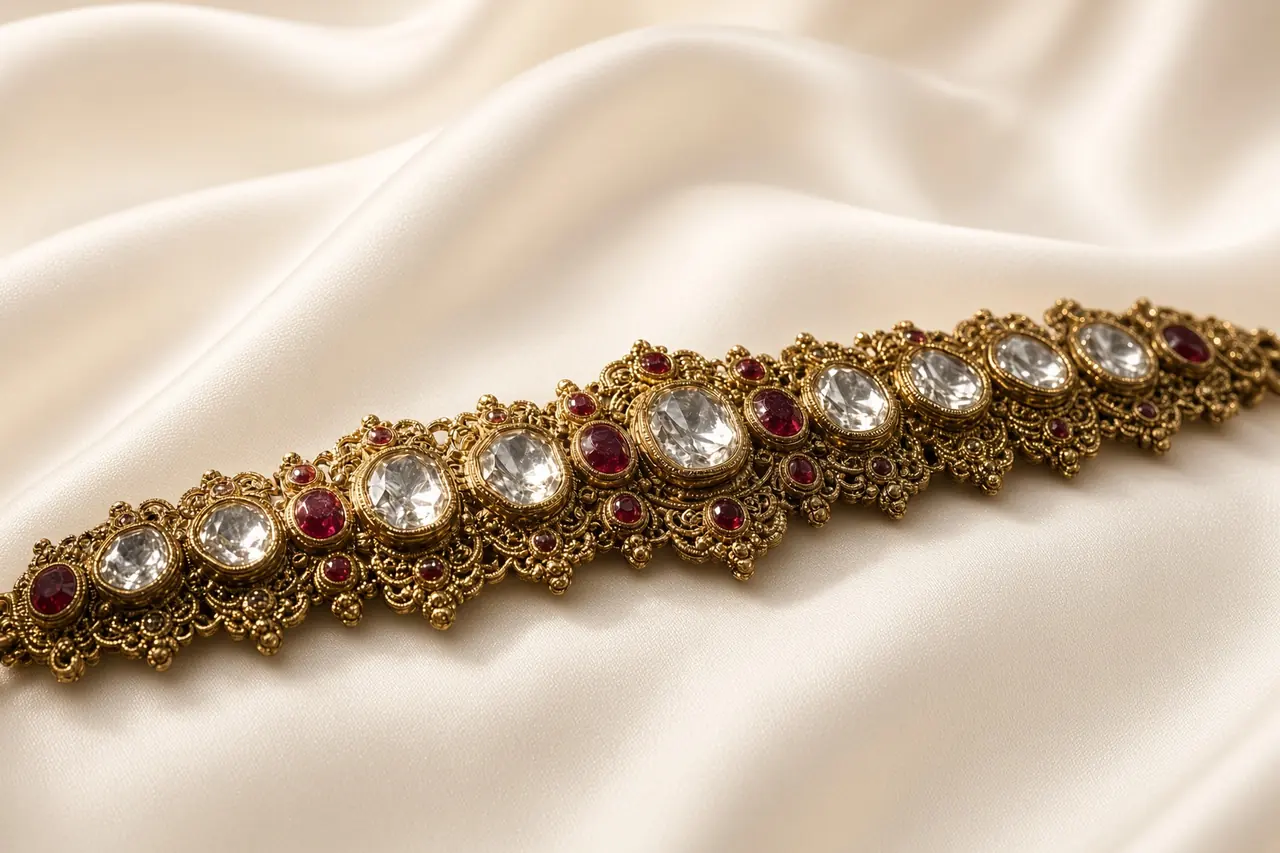
South Indian and Deccan temples set uncut diamonds, rubies and emeralds into gold as offerings, not as fashion. The stone was a graha, a vow, a treasury. Kundan and polki grow from this habit of leaving the crystal close to the way it came from the earth.
Mughal ateliers
The carved emerald and the spinel
Imperial workshops in Agra and Delhi favoured large Colombian emeralds, Balas rubies (spinels), and diamonds from Golconda. Inscriptions were cut into the table of a stone. The idea that a gem could carry a name — of a king, a saint, a house — is not new.
Golconda
The old Indian diamond
Before Brazil and South Africa, the Krishna delta supplied the world’s diamonds. Golconda stones are typically type IIa — without the nitrogen that tints a cape yellow. They are why Indian jewellery still prefers a living fire to a laboratory’s “ideal cut” diagram.
Colonial trade
Ceylon, Burma, Siam
Colombo, Mogok and Chanthaburi became the ports through which sapphires and rubies entered Bombay and Madras. Heat treatment of corundum, already known to older burners, became an industry. Honest cabinets have been declaring it ever since.
Today
A report, a loupe, a north window
Laboratories in Jaipur, Mumbai and Surat issue notes on origin and treatment. They do not replace looking. A stone that only lives under a spot will fail in a Solapur noon. That is still the test we use.
The Navratna, as we keep it
A complete Navratna is nine stones in one setting, each for a graha. Most clients begin with a single stone. Both are traditional. Neither is a medical device. Explore traditional benefits.
| Stone | Sanskrit | Graha | Day |
|---|---|---|---|
| Ruby | Manikya | Sun (Surya) | Sunday |
| Pearl | Moti | Moon (Chandra) | Monday |
| Red Coral | Moonga | Mars (Mangala) | Tuesday |
| Emerald | Panna | Mercury (Budha) | Wednesday |
| Yellow Sapphire | Pukhraj | Jupiter (Guru) | Thursday |
| Diamond | Heera | Venus (Shukra) | Friday |
| Blue Sapphire | Neelam | Saturn (Shani) | Saturday |
| Hessonite | Gomed | Rahu (Rahu) | Saturday |
| Cat’s Eye | Lehsunia | Ketu (Ketu) | Thursday |